The word “innocent” in innocent spouse relief can be misleading. It doesn’t imply you’re perfect or blameless – it’s more about whether you knew or should have known about the tax issue. The IRS defines “innocence” in a specific way, and it hinges on the concept of reasonable ignorance. In short, the issue isn’t one of morality; it’s about whether you could have reasonably been unaware of a tax problem.
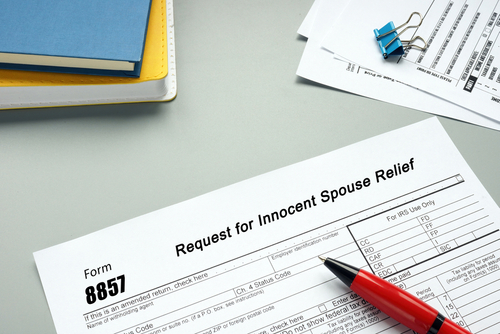
Innocent spouse relief allows you to avoid being held responsible for tax debts, penalties, and interest stemming from a joint tax filing. In the case that a spouse (or ex-spouse) made an error that led to a tax issue, regardless of intention, you may not have to shoulder the burden. Say your income wasn’t reported, excessive deductions were claimed, or tax fraud was committed. If you meet the IRS criteria, you can request relief by submitting Form 8857.
Qualifications for Innocent Spouse Relief
To qualify, you must meet several conditions.
Joint Tax Return: The tax liability must arise from a joint return. When you file together, both spouses are equally responsible for any tax issues that arise.
Tax Underreporting: The tax issue must stem from underreported income or an incorrect claim for deductions or credits. This could involve unreported income (like from offshore accounts) or fraudulent deductions made by your spouse.
Lack of Knowledge: You must show that, at the time of filing, you were unaware of the problem and had no reason to suspect it.
Unfair Responsibility: Lastly, it must be deemed unjust to hold you liable. The IRS looks at factors such as whether you benefited from the underreported taxes (e.g., through extravagant spending) or if you’ve divorced.
What Doesn’t Qualify for Innocent Spouse Relief?
Not all cases involving a spouse’s financial mismanagement qualify for relief. The IRS may reject your claim in the following situations:
Awareness of the Mistake: If you knew about the issue or should have known, you won’t be eligible for relief. Simply stating that you didn’t read the return won’t suffice. The IRS expects you to recognize obvious errors if you have access to the relevant information.
Divorce Doesn’t Automatically Provide Relief: Divorce alone doesn’t eliminate your liability for tax debt. Joint returns create shared responsibility, and being separated or divorced doesn’t mean the IRS will automatically release you from this obligation. You must prove your innocence through the relief process.
Disagreements Over Personal Spending: If your spouse’s spending decisions are something you disagree with, the IRS will not consider it a tax issue unless it involves unreported income or fraudulent deductions. The IRS focuses on tax matters, not marital conflicts over financial choices.
Pros and Cons of Filing
Advantages include:
Avoid Financial Hardship: Tax liabilities, along with interest and penalties, can be overwhelming. Innocent spouse relief can protect you from these financial burdens.
Clear Your Name: If you’ve been unfairly tied to a tax issue you didn’t cause, the relief process can help remove you from the responsibility.
Peace of Mind: Successfully claiming relief can bring emotional relief, especially if you’ve gone through a challenging marriage.
Potential drawbacks are:
No Guarantee of Approval: The IRS does not grant relief easily. You’ll need to provide strong evidence, and the process can be lengthy and difficult.
Time Limitations: You generally must apply for relief within two years of the IRS starting collection efforts. Missing this deadline could result in losing the opportunity for relief.
Invasive Process: The IRS will closely examine your financial and personal life, including details about your marriage and finances, which could feel intrusive if you value your privacy.
Possible Strain on Relationships: If you’re still married, filing for relief could cause tension, as it might be seen as blaming your spouse for the tax issue.
Conclusion
To request innocent spouse relief, you’ll need to file Form 8857. Be prepared to provide details about the tax years involved, explain why you didn’t know about the issue, and any supporting documents (like bank statements, emails, or divorce decrees.
After submitting the form, the IRS will notify your spouse or ex-spouse, who will have a chance to respond by a specific date.
Alan F Burke CPA
What is Innocent Spouse Relief?
January 1, 2025 · Blog, Tax and Financial News
⏱ 4 min read
The word “innocent” in innocent spouse relief can be misleading. It doesn’t imply you’re perfect or blameless – it’s more about whether you knew or should have known about the tax issue. The IRS defines “innocence” in a specific way, and it hinges on the concept of reasonable ignorance. In short, the issue isn’t one of morality; it’s about whether you could have reasonably been unaware of a tax problem.
Innocent spouse relief allows you to avoid being held responsible for tax debts, penalties, and interest stemming from a joint tax filing. In the case that a spouse (or ex-spouse) made an error that led to a tax issue, regardless of intention, you may not have to shoulder the burden. Say your income wasn’t reported, excessive deductions were claimed, or tax fraud was committed. If you meet the IRS criteria, you can request relief by submitting Form 8857.
Qualifications for Innocent Spouse Relief
To qualify, you must meet several conditions.
Joint Tax Return: The tax liability must arise from a joint return. When you file together, both spouses are equally responsible for any tax issues that arise.
Tax Underreporting: The tax issue must stem from underreported income or an incorrect claim for deductions or credits. This could involve unreported income (like from offshore accounts) or fraudulent deductions made by your spouse.
Lack of Knowledge: You must show that, at the time of filing, you were unaware of the problem and had no reason to suspect it.
Unfair Responsibility: Lastly, it must be deemed unjust to hold you liable. The IRS looks at factors such as whether you benefited from the underreported taxes (e.g., through extravagant spending) or if you’ve divorced.
What Doesn’t Qualify for Innocent Spouse Relief?
Not all cases involving a spouse’s financial mismanagement qualify for relief. The IRS may reject your claim in the following situations:
Awareness of the Mistake: If you knew about the issue or should have known, you won’t be eligible for relief. Simply stating that you didn’t read the return won’t suffice. The IRS expects you to recognize obvious errors if you have access to the relevant information.
Divorce Doesn’t Automatically Provide Relief: Divorce alone doesn’t eliminate your liability for tax debt. Joint returns create shared responsibility, and being separated or divorced doesn’t mean the IRS will automatically release you from this obligation. You must prove your innocence through the relief process.
Disagreements Over Personal Spending: If your spouse’s spending decisions are something you disagree with, the IRS will not consider it a tax issue unless it involves unreported income or fraudulent deductions. The IRS focuses on tax matters, not marital conflicts over financial choices.
Pros and Cons of Filing
Advantages include:
Avoid Financial Hardship: Tax liabilities, along with interest and penalties, can be overwhelming. Innocent spouse relief can protect you from these financial burdens.
Clear Your Name: If you’ve been unfairly tied to a tax issue you didn’t cause, the relief process can help remove you from the responsibility.
Peace of Mind: Successfully claiming relief can bring emotional relief, especially if you’ve gone through a challenging marriage.
Potential drawbacks are:
No Guarantee of Approval: The IRS does not grant relief easily. You’ll need to provide strong evidence, and the process can be lengthy and difficult.
Time Limitations: You generally must apply for relief within two years of the IRS starting collection efforts. Missing this deadline could result in losing the opportunity for relief.
Invasive Process: The IRS will closely examine your financial and personal life, including details about your marriage and finances, which could feel intrusive if you value your privacy.
Possible Strain on Relationships: If you’re still married, filing for relief could cause tension, as it might be seen as blaming your spouse for the tax issue.
Conclusion
To request innocent spouse relief, you’ll need to file Form 8857. Be prepared to provide details about the tax years involved, explain why you didn’t know about the issue, and any supporting documents (like bank statements, emails, or divorce decrees.
After submitting the form, the IRS will notify your spouse or ex-spouse, who will have a chance to respond by a specific date.
Disclaimer
These articles provide general information on tax, accounting, and financial topics for small businesses and individuals. They are educational in nature and are not specific legal, accounting, financial, tax, or other professional advice, and should not be relied upon as such. This content was prepared by Service2Client and may have been reviewed or edited by the website owner for accuracy and compliance. Look for a trust mark below for verification details. No representation is made that any approach described will achieve a particular result, and no regulatory or professional body has reviewed or endorsed this content. Because each situation is different, readers should consult a qualified professional about their specific circumstances before acting. Images accompanying these articles are protected by copyright and may not be copied or reused.
Personal Income Tax Planning Strategies for Year-End 2024
As 2024 draws to a close, it’s the perfect time to review your personal income tax situation and implement strategies to minimize your tax liability for the year. Proactive year-end tax planning can lead to significant savings, as well as ensure that you take full advantage of tax credits, deductions and other opportunities available to you.
1. Maximize Contributions to Retirement Accounts
One of the most effective ways to reduce your taxable income is by contributing to tax-advantaged retirement accounts. In 2024, you may contribute up to $23,000 to a 401(k) or similar employer-sponsored plan, with an additional $7,500 catch-up contribution if you’re over age 50. These contributions are made pre-tax, meaning they reduce your taxable income for the year, potentially lowering your tax bill.
Similarly, if you’re eligible, consider contributing to an IRA. For 2024, the maximum contribution limit for a traditional IRA and/or Roth IRA is $7,000 ($8,000 if you’re 50 or older). Contributions to a traditional IRA may be tax-deductible depending on your income and whether you or your spouse are covered by an employer-sponsored retirement plan. If you’re not eligible for deductions due to income limits, consider a Roth IRA, where contributions are made after-tax, but qualified withdrawals in retirement are tax-free.
2. Take Advantage of Flexible Spending Accounts (FSAs) and Health Savings Accounts (HSAs)
If your employer offers a Flexible Spending Account (FSA), use the remainder of your FSA funds before they expire. FSAs allow you to put away pre-tax money to cover medical expenses, and the limit for 2024 is $3,200. Depending on your employer’s plan, unused funds may be forfeited after the year-end, although some plans may offer a grace period or carryover option for a small portion of the balance.
For those eligible for a Health Savings Account (HSA), contributing the maximum allowable amount can provide immediate tax savings. For 2024, the HSA contribution limit is $4,150 for individuals and $8,300 for families, with an additional $1,000 catch-up contribution for individuals age 55 or older.
3. Harvest Capital Losses
If you’ve realized capital gains in 2024, it may be beneficial to offset those gains with capital losses. Known as tax-loss harvesting, this strategy involves selling investments that have declined in value to realize losses, which can be used to offset your capital gains. If your capital losses exceed your gains, you can use the remaining losses to offset up to $3,000 of ordinary income ($1,500 if married and filing separately).
Make sure to consider the “wash sale” rule, which disallows a deduction if you buy the same or substantially identical security within 30 days of selling at a loss. This rule is meant to prevent taxpayers from selling assets for tax benefits and then repurchasing the same assets immediately.
4. Bunch Charitable Contributions
If you’re planning to make charitable donations, consider bunching your contributions into one year to exceed the standard deduction threshold. This strategy allows you to itemize deductions for one year by making larger charitable contributions in a single year while taking the standard deduction in the following year. The standard deduction for 2024 is $29,200 for married couples filing jointly and $14,600 for single filers, which means if your itemized deductions do not exceed these amounts, you may benefit from grouping two or more years’ worth of charitable donations into one year.
5. Review Your Tax Withholding
As the year ends, review your tax withholding to ensure you’re not over- or under-paying throughout the year. If you’ve had a major life change in 2024, such as marriage, divorce, a child or a new job, adjusting your withholding can prevent underpayment penalties or a large tax bill. You can use the IRS Tax Withholding Estimator tool to assess whether your withholding is on track or, if necessary, submit a new Form W-4 to adjust your withholding for the final paychecks of the year.
6. Plan for Estimated Taxes if Self-Employed
For self-employed individuals, it’s important to ensure you’ve made sufficient estimated tax payments throughout the year. If you expect to owe additional taxes for 2024, you may want to increase your final estimated payment by Jan. 15, 2025, to avoid penalties. You can calculate your estimated tax liability using Form 1040-ES.
Conclusion
Tax planning is an essential part of personal finance. With 2024 coming to an end, it’s the right time to review your finances and take advantage of available tax-saving opportunities. By maximizing retirement account contributions, considering tax-loss harvesting and utilizing other year-end strategies, you can minimize your tax burden and keep more of your hard-earned income. Be sure to consult with a tax professional to tailor these strategies to your unique financial situation and ensure you’re in the best possible position for the year ahead.
Alan F Burke CPA
Tax Planning 2024
December 1, 2024 · Blog, Tax and Financial News
⏱ 4 min read
Personal Income Tax Planning Strategies for Year-End 2024
As 2024 draws to a close, it’s the perfect time to review your personal income tax situation and implement strategies to minimize your tax liability for the year. Proactive year-end tax planning can lead to significant savings, as well as ensure that you take full advantage of tax credits, deductions and other opportunities available to you.
1. Maximize Contributions to Retirement Accounts
One of the most effective ways to reduce your taxable income is by contributing to tax-advantaged retirement accounts. In 2024, you may contribute up to $23,000 to a 401(k) or similar employer-sponsored plan, with an additional $7,500 catch-up contribution if you’re over age 50. These contributions are made pre-tax, meaning they reduce your taxable income for the year, potentially lowering your tax bill.
Similarly, if you’re eligible, consider contributing to an IRA. For 2024, the maximum contribution limit for a traditional IRA and/or Roth IRA is $7,000 ($8,000 if you’re 50 or older). Contributions to a traditional IRA may be tax-deductible depending on your income and whether you or your spouse are covered by an employer-sponsored retirement plan. If you’re not eligible for deductions due to income limits, consider a Roth IRA, where contributions are made after-tax, but qualified withdrawals in retirement are tax-free.
2. Take Advantage of Flexible Spending Accounts (FSAs) and Health Savings Accounts (HSAs)
If your employer offers a Flexible Spending Account (FSA), use the remainder of your FSA funds before they expire. FSAs allow you to put away pre-tax money to cover medical expenses, and the limit for 2024 is $3,200. Depending on your employer’s plan, unused funds may be forfeited after the year-end, although some plans may offer a grace period or carryover option for a small portion of the balance.
For those eligible for a Health Savings Account (HSA), contributing the maximum allowable amount can provide immediate tax savings. For 2024, the HSA contribution limit is $4,150 for individuals and $8,300 for families, with an additional $1,000 catch-up contribution for individuals age 55 or older.
3. Harvest Capital Losses
If you’ve realized capital gains in 2024, it may be beneficial to offset those gains with capital losses. Known as tax-loss harvesting, this strategy involves selling investments that have declined in value to realize losses, which can be used to offset your capital gains. If your capital losses exceed your gains, you can use the remaining losses to offset up to $3,000 of ordinary income ($1,500 if married and filing separately).
Make sure to consider the “wash sale” rule, which disallows a deduction if you buy the same or substantially identical security within 30 days of selling at a loss. This rule is meant to prevent taxpayers from selling assets for tax benefits and then repurchasing the same assets immediately.
4. Bunch Charitable Contributions
If you’re planning to make charitable donations, consider bunching your contributions into one year to exceed the standard deduction threshold. This strategy allows you to itemize deductions for one year by making larger charitable contributions in a single year while taking the standard deduction in the following year. The standard deduction for 2024 is $29,200 for married couples filing jointly and $14,600 for single filers, which means if your itemized deductions do not exceed these amounts, you may benefit from grouping two or more years’ worth of charitable donations into one year.
5. Review Your Tax Withholding
As the year ends, review your tax withholding to ensure you’re not over- or under-paying throughout the year. If you’ve had a major life change in 2024, such as marriage, divorce, a child or a new job, adjusting your withholding can prevent underpayment penalties or a large tax bill. You can use the IRS Tax Withholding Estimator tool to assess whether your withholding is on track or, if necessary, submit a new Form W-4 to adjust your withholding for the final paychecks of the year.
6. Plan for Estimated Taxes if Self-Employed
For self-employed individuals, it’s important to ensure you’ve made sufficient estimated tax payments throughout the year. If you expect to owe additional taxes for 2024, you may want to increase your final estimated payment by Jan. 15, 2025, to avoid penalties. You can calculate your estimated tax liability using Form 1040-ES.
Conclusion
Tax planning is an essential part of personal finance. With 2024 coming to an end, it’s the right time to review your finances and take advantage of available tax-saving opportunities. By maximizing retirement account contributions, considering tax-loss harvesting and utilizing other year-end strategies, you can minimize your tax burden and keep more of your hard-earned income. Be sure to consult with a tax professional to tailor these strategies to your unique financial situation and ensure you’re in the best possible position for the year ahead.
Disclaimer
These articles provide general information on tax, accounting, and financial topics for small businesses and individuals. They are educational in nature and are not specific legal, accounting, financial, tax, or other professional advice, and should not be relied upon as such. This content was prepared by Service2Client and may have been reviewed or edited by the website owner for accuracy and compliance. Look for a trust mark below for verification details. No representation is made that any approach described will achieve a particular result, and no regulatory or professional body has reviewed or endorsed this content. Because each situation is different, readers should consult a qualified professional about their specific circumstances before acting. Images accompanying these articles are protected by copyright and may not be copied or reused.
According to estimates, inflation adjustments to the Internal Revenue Code are expected to yield increases of 2.8 percent compared to 2024 amounts. This means wider tax brackets and increased exemptions, among other things. With the U.S. Bureau of Labor Statistics consumer price index (CPI) moderating, this increase is about 50 percent less than 2024’s inflation adjustment. Below, we’ll look at what the projected 2025 inflation adjustment means in terms of dollars and cents for you and your taxes.
Individual Income Tax Brackets
The tables below illustrate the individual income tax rates and brackets for 2025.
Individual Income Tax Brackets & Rates: Tax Year 2025
Single Taxpayers
10%
0 – $11,925
12%
$11,926 – $48,475
22%
$48,476 – $103,350
24%
$103,351 – $197,300
32%
$197,301 – $250,525
35%
$250,526 – $626,350
37%
$626,351 and Over
Married Filing Jointly
10%
0 – $23,850
12%
$23,851 – $96,950
22%
$96,951 – $206,700
24%
$206,701 – $394,600
32%
$394,601 – $501,050
35%
$501,051 – $751,600
37%
$751,601 and Over
Married Filing Separately
10%
0 – $11,925
12%
$11,926 – $48,475
22%
$48,476 – $103,350
24%
$103,351 – $197,300
32%
$197,301 – $250,525
35%
$250,526 – $375,800
37%
$375,801 and Over
Heads of Household
10%
0 – $17,000
12%
$17,001- $64,850
22%
$64,851 – $103,350
24%
$103,351 – $197,300
32%
$197,301 – $250,500
35%
$250,501 – $626,350
37%
$626,351 and Over
Trusts & Estates Tax Brackets
The table below illustrates what the income rates and brackets are expected to look like for Trusts and Estates in 2025.
Projected Trusts and Estates Tax Brackets & Rates: Tax Year 2025
10%
0 – $3,150
24%
$3,151- $11,450
35%
$11,451 – $15,650
37%
$15,651 and Over
Standard Deduction Amounts
The table below illustrates what the projected standard deduction amounts will be for 2025, with a comparison to 2024.
Projected Standard Deduction Amounts
2024
2025
Single
$14,600
$15,750
Married Filing Jointly
$29,200
$31,500
Married Filing Separately
$14,600
$15,750
Head of Household
$21,900
$23,625
Alternative Minimum Tax (AMT)
The table below illustrates the anticipated AMT exemptions for 2025.
AMT Exemption Amounts Tax Year 2025
Single
$88,100
Married Filing Jointly
$137,000
Married Filing Separately
$68,500
Trust & Estates
$30,700
Capital Gains
The rates applied to long-term capital gains are not expected to change for 2025; however, the brackets that apply to different rates will expand. Note that, in considering the table below, a 20 percent tax rate applies to capital gains that are over the 37 percent ordinary tax rate threshold. Furthermore, capital gains on art and collectibles are subject to other exceptions.
Maximum Capital Gains Rates for 2025
Zero Rate
15% Rate
Single
$48,350
$533,400
Married Filing Jointly
$96,700
$600,050
Married Filing Separately
$48,350
$300,000
Head of Household
$64,750
$566,700
Trusts & Estates
$3,250
$15,900
Conclusion
First, it’s important to remember that all the figures above are only projections. The IRS will not publish the official numbers until later this year. Moreover, as these rates and brackets have increased, they have done so significantly less than in 2024 and 2023, largely driven by lower inflation.
Alan F Burke CPA
2025 Federal Income Tax Brackets
November 1, 2024 · Blog, Tax and Financial News
⏱ 2 min read
According to estimates, inflation adjustments to the Internal Revenue Code are expected to yield increases of 2.8 percent compared to 2024 amounts. This means wider tax brackets and increased exemptions, among other things. With the U.S. Bureau of Labor Statistics consumer price index (CPI) moderating, this increase is about 50 percent less than 2024’s inflation adjustment. Below, we’ll look at what the projected 2025 inflation adjustment means in terms of dollars and cents for you and your taxes.
Individual Income Tax Brackets
The tables below illustrate the individual income tax rates and brackets for 2025.
Individual Income Tax Brackets & Rates: Tax Year 2025
Single Taxpayers
10%
0 – $11,925
12%
$11,926 – $48,475
22%
$48,476 – $103,350
24%
$103,351 – $197,300
32%
$197,301 – $250,525
35%
$250,526 – $626,350
37%
$626,351 and Over
Married Filing Jointly
10%
0 – $23,850
12%
$23,851 – $96,950
22%
$96,951 – $206,700
24%
$206,701 – $394,600
32%
$394,601 – $501,050
35%
$501,051 – $751,600
37%
$751,601 and Over
Married Filing Separately
10%
0 – $11,925
12%
$11,926 – $48,475
22%
$48,476 – $103,350
24%
$103,351 – $197,300
32%
$197,301 – $250,525
35%
$250,526 – $375,800
37%
$375,801 and Over
Heads of Household
10%
0 – $17,000
12%
$17,001- $64,850
22%
$64,851 – $103,350
24%
$103,351 – $197,300
32%
$197,301 – $250,500
35%
$250,501 – $626,350
37%
$626,351 and Over
Trusts & Estates Tax Brackets
The table below illustrates what the income rates and brackets are expected to look like for Trusts and Estates in 2025.
Projected Trusts and Estates Tax Brackets & Rates: Tax Year 2025
10%
0 – $3,150
24%
$3,151- $11,450
35%
$11,451 – $15,650
37%
$15,651 and Over
Standard Deduction Amounts
The table below illustrates what the projected standard deduction amounts will be for 2025, with a comparison to 2024.
Projected Standard Deduction Amounts
2024
2025
Single
$14,600
$15,750
Married Filing Jointly
$29,200
$31,500
Married Filing Separately
$14,600
$15,750
Head of Household
$21,900
$23,625
Alternative Minimum Tax (AMT)
The table below illustrates the anticipated AMT exemptions for 2025.
AMT Exemption Amounts Tax Year 2025
Single
$88,100
Married Filing Jointly
$137,000
Married Filing Separately
$68,500
Trust & Estates
$30,700
Capital Gains
The rates applied to long-term capital gains are not expected to change for 2025; however, the brackets that apply to different rates will expand. Note that, in considering the table below, a 20 percent tax rate applies to capital gains that are over the 37 percent ordinary tax rate threshold. Furthermore, capital gains on art and collectibles are subject to other exceptions.
Maximum Capital Gains Rates for 2025
Zero Rate
15% Rate
Single
$48,350
$533,400
Married Filing Jointly
$96,700
$600,050
Married Filing Separately
$48,350
$300,000
Head of Household
$64,750
$566,700
Trusts & Estates
$3,250
$15,900
Conclusion
First, it’s important to remember that all the figures above are only projections. The IRS will not publish the official numbers until later this year. Moreover, as these rates and brackets have increased, they have done so significantly less than in 2024 and 2023, largely driven by lower inflation.
Disclaimer
These articles provide general information on tax, accounting, and financial topics for small businesses and individuals. They are educational in nature and are not specific legal, accounting, financial, tax, or other professional advice, and should not be relied upon as such. This content was prepared by Service2Client and may have been reviewed or edited by the website owner for accuracy and compliance. Look for a trust mark below for verification details. No representation is made that any approach described will achieve a particular result, and no regulatory or professional body has reviewed or endorsed this content. Because each situation is different, readers should consult a qualified professional about their specific circumstances before acting. Images accompanying these articles are protected by copyright and may not be copied or reused.

 The word “innocent” in innocent spouse relief can be misleading. It doesn’t imply you’re perfect or blameless – it’s more about whether you knew or should have known about the tax issue. The IRS defines “innocence” in a specific way, and it hinges on the concept of reasonable ignorance. In short, the issue isn’t one of morality; it’s about whether you could have reasonably been unaware of a tax problem.


 Personal Income Tax Planning Strategies for Year-End 2024
 According to estimates, inflation adjustments to the Internal Revenue Code are expected to yield increases of 2.8 percent compared to 2024 amounts. This means wider tax brackets and increased exemptions, among other things. With the U.S. Bureau of Labor Statistics consumer price index (CPI) moderating, this increase is about 50 percent less than 2024’s inflation adjustment. Below, we’ll look at what the projected 2025 inflation adjustment means in terms of dollars and cents for you and your taxes.